The son of the maker Boston violin teachers called “the Stradivarius of America,” and the point where a bench trade became a string factory. Jerome Bonaparte Squier’s memorial entry in the 1916 Violinist’s Guide — 608 violins made and reconstructed, the “Apostles” series of twelve, each named after an apostle — stands on the same page as his son’s plain line: maker, repairer and dealer at 429 Lake Ave., Battle Creek, Michigan, manufacturer of wound strings. Ayars’s 1937 history of the Boston trade supplies the join the directory only implies — Victor Carroll “worked with him” before opening his own business — and notes the family had come from Michigan in the first place. By 1928 his labels, carrying the full name the directory abbreviates over a VCS monogram, were numbered to at least 695. What no source here supplies is a single personal date for him.
- Places and dates of work
- Battle Creek, Michigan — 429 Lake Ave., coded “m.r.d.”, maker, repairer and dealer, in the 1916 trade directory. documented read from the page image
- Output (claimed and documented)
- Manufacturer of wound strings, alongside making, repair and dealing. reported read from the page image
- Partners, pupils, employees
- Son of Jerome Bonaparte Squier (born Ohio 1838, died Boston 1912), and worked with him: “His son, Victor Carroll, who worked with him, now has his own business in Battle Creek, Michigan, as stringed instrument maker, repairer and dealer, and manufacturer of wound strings.” The family’s road ran through Michigan: the father “came from Michigan to Lewiston, Maine,” where he took up violins, and thence to Boston. reported read from the page image
- Partners, pupils, employees
- “Son of J. B. Squier” — the directory’s line; the father’s memorial entry stands on the same page: “Made and reconstructed 608 violins… One of foremost American makers; work highly esteemed,” with the “Apostles” series of twelve violins, each named after an apostle, and the “George Washington” and “Abraham Lincoln.” reported read from the page image
- Partners, pupils, employees
- The father’s standing in the reference literature: “after the Civil War noted as one of the best American violin-makers, with headquarters at Boston.” reported read from the page image
- Numbering practice
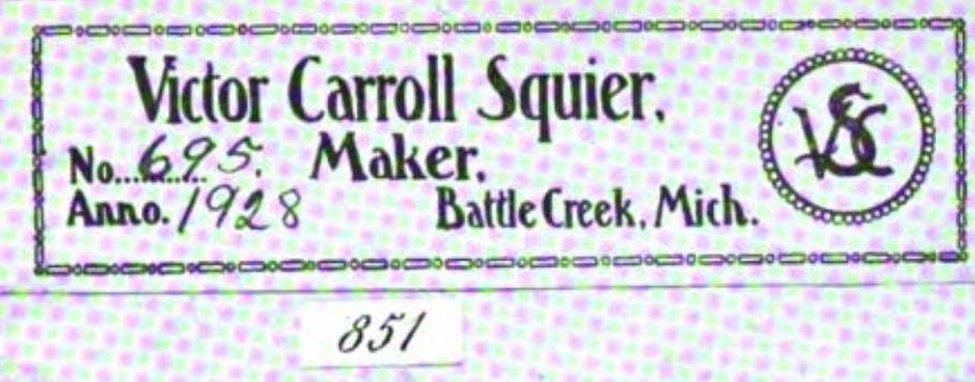
- Instrument No. 695 by 1928: the label facsimile in Poidras reads “No. 695 … Anno 1928,” both completed in manuscript. documented read from the page image
- Labels and brands
- Printed label: “Victor Carroll Squier, Maker, Battle Creek, Mich.”, with “No.” and “Anno” blanks completed in manuscript and a circular VCS monogram at the right. documented read from the page image
- What is not known
- His dates, and everything after 1928. No birth or death year is attested in the corpus — the Guide and Ayars both leave him living and undated — and the string business’s later history under his name is outside the evidence held. Michigan vital records or Battle Creek directories would settle the dates; the Guide’s later editions (1917, 1920, 1924) would date the shop. disputed [no source recorded]
Instruments
No instruments recorded yet for this maker.