Violin makerNew York1816–1899
As printed
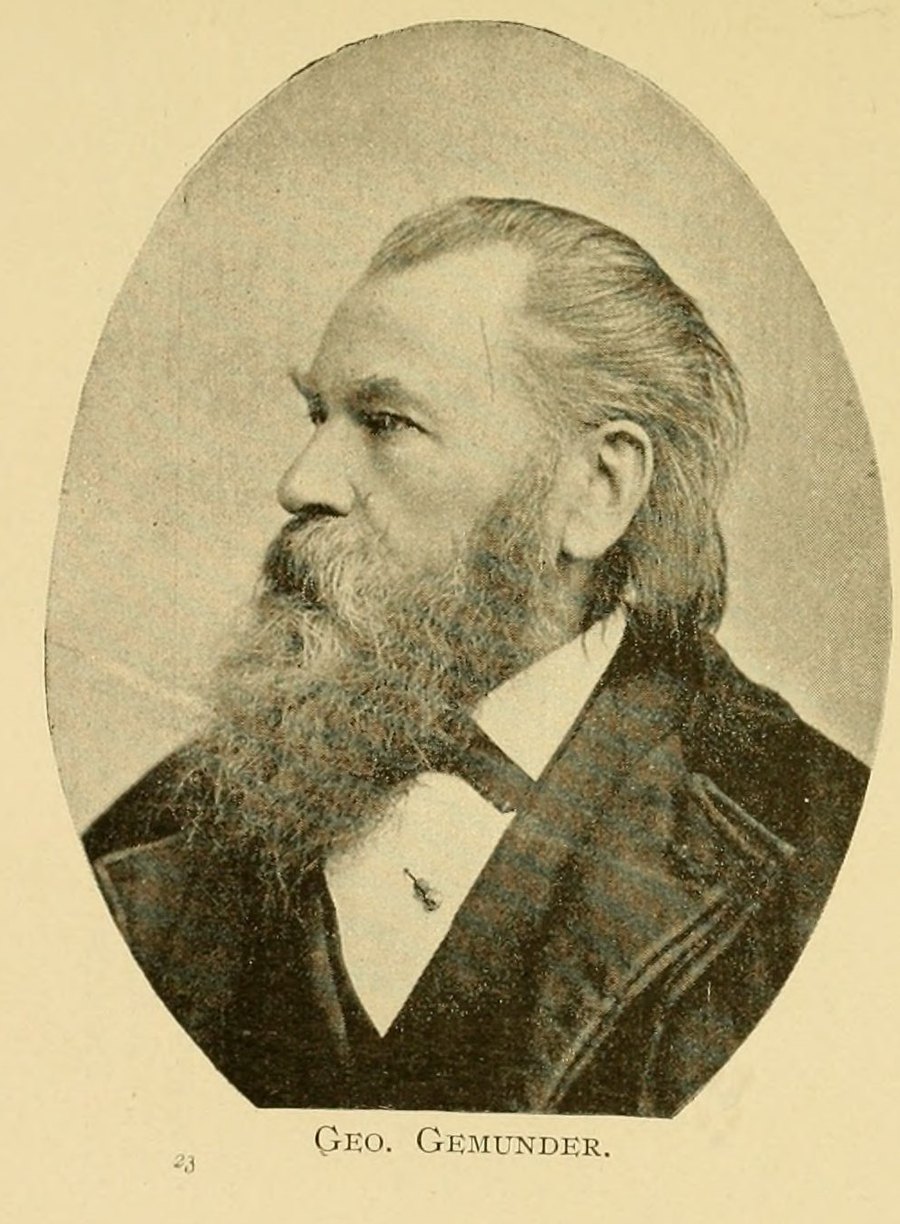
This claim names a source that has no page on this site yet, so it cannot be checked. It is shown rather than hidden.Which George is which, in any given attribution: the maker (1816–1899) and his son George (d. 1915) shared the name entire, and no instrument, label or sale on disk is assigned between them. Also unestablished: a death record behind the index’s 1899 — Howe (1889) leaves him alive and working in New York, so the death falls between that press date and the 1916 directory’s “Deceased”; and the identity of the Paris exposition, which Howe, naming only the London prizes, does nothing to supply. Of the six works the WPA index keys his entry to, Hubbard and now Howe (pp. 347–49, with the portrait) are on disk and read; Grove’s American Supplement, Jones’s Handbook, Pratt’s encyclopedia and the Ayars pages (198, 228) remain unread.
This record is assembly of what is on disk, and says so. Howe’s three pages are read from the page images, staged at sources/incoming/hundred-years-1889/ with the full-volume machine text beside them.
A Hundred Years of Music in America (1889)
13 April 1816, at Ingelfingen in Württemberg.
Howe’s sketch, pp. 347–48, read from the page images — published in Gemunder’s lifetime, its detail presumably from the man or his circle, and the only source on disk to give the day. Hubbard (1908) and the WPA index carry the same year; his brother August was born in the same town in 1814. No civil record on disk.view the page image
In 1847 “he received an invitation from his two brothers residing in America to visit this country.” A concert venture with the brothers was “not lucrative,” and “borrowing twenty-five dollars as capital to invest in business, he went to Boston to engage in violin making.”
Howe, pp. 347–48, published in his lifetime. It conflicts with Hubbard’s account alongside: there the emigration is “it is said upon the advice of Ole Bull” — yet in Howe, Gemunder first calls on Bull in New York in 1852, and Bull is astonished to learn he had left Vuillaume at all. The year 1847 is common ground; the occasion is not.view the page image
Bred to the craft — his father “was a maker of bow instruments”; schooled for teaching instead; after his father died in his nineteenth year he went through Pesth, Presburg, Vienna and Munich, then obtained an engagement with Vuillaume and remained several years in the Paris shop, “making and repairing violins for the distinguished artists and amateurs of the day.”
Howe, pp. 347–48, read from the page images: unfootnoted, in his lifetime, and almost certainly his own telling. The 1916 Guide (“pupil of Vuillaume”) and Hubbard (“a pupil of Baptiste Vuillaume of Paris”) say the same; none of the three shows a document.view the page image
Boston, from soon after the 1847 arrival until about 1851 — the business there “was not remunerative” — then New York: “Mr. Gemunder has remained in New York ever since,” still at work there when the sketch went to press in 1889.
Howe, p. 348. It gives no street addresses and mentions neither Astoria nor the partnership with August; its dating is narrative order — arrival 1847, the London exposition of 1851 sent from Boston, the Ole Bull call of 1852 in New York.view the page image
First prizes at the London exposition of 1851, for “a quartette of bow instruments in imitation of Stradivarious, also several other violins,” sent while he worked in Boston; the news reached him in New York, “shortly after his arrival.”
Howe, p. 348, read from the page image. Hubbard (1908) concurs — “medals at the World’s Fair in London, 1851,” for violins of the Boston years — but both are unfootnoted trade accounts, no exhibition record is on disk, and Howe’s sketch was surely built from the man’s own telling.view the page image
Ole Bull — on whom he called in New York in 1852, and to whom, over a violin Bull “believed Vuilluame had repaired for him,” Gemunder “proved to Mr. Bull that he, himself, and not the master workman, had done the marvelous repairing.”
Howe, p. 348, read from the page image — told in Gemunder’s lifetime, almost certainly from his side of the story, and Bull, dead in 1880, could not gainsay it. The scene is also the record’s quiet witness against Hubbard’s later claim that Gemunder emigrated on Bull’s advice.view the page image
History of American Music (1908)
To the United States about 1847 — “a year later than did his brother” August, who came in 1846, “it is said upon the advice of Ole Bull.” First in Boston; to New York in 1852.
Hubbard’s account, published a half-century after the events, and its Ole Bull motive — already hedged by Hubbard’s own “it is said” — sits badly against Howe (1889), where Bull and Gemunder first meet in New York in 1852 and Bull does not know he has left Vuillaume; Howe has instead an invitation from two brothers already in America. On the move to New York the two roughly agree: Hubbard says 1852, Howe puts it before the news of the 1851 London awards arrived.
Worked in natural, chemically untreated wood — “one of his most valuable discoveries was how to acquire results by means of natural woods, whereas Vuillaume and other makers of violins had thought it necessary to treat the wood chemically.”
Hubbard’s praise, unfootnoted, and aimed at the man’s own teacher; trade lore rather than a documented method. Nothing of it in Howe (1889), whose sketch credits him only generally with mastery of the recovered Stradivari principles.
His violins “often are mistaken for Cremonas”; one, called the “Kaiser,” sent to the Vienna Exposition, was pronounced by the judges an old Italian instrument.
Hubbard cites nothing for the story; neither the “Kaiser” nor Vienna appears in Howe (1889), and no exposition record on disk mentions either. Mistaken-for-Cremona is the trade’s favourite compliment — and, for a reference built on attribution, also its warning.
Show all 6 printings
The Violinist's Guide: Written for the Use of the Violin Buying Public (1916)
New York, in business with his brother August; later independent in Astoria.
The Guide, p. 27, read from the page image. Howe (1889) names neither the partnership nor Astoria — its sketch simply keeps him in New York from the early 1850s on.
“The violins of George Gemunder took highest awards at Centennial Exposition, Philadelphia, 1876; at Paris Exposition” — the Paris fair unnamed and undated.
The directory’s claim, in a compiled entry; no award record from either exposition is on disk. Howe (1889), listing his honours in his lifetime, names only the London prizes of 1851 and otherwise says “many medals” — it neither mentions the Centennial nor identifies any Paris fair.
Brother and partner: August Gemunder. The successor firm, August Gemunder & Sons of 141 W. 42nd St., stands in the same 1916 directory, its president — another August — described there as “nephew of George Gemunder.”
Both entries on p. 27 of the Guide. The WPA index dates the elder August 1814–1895. Howe (1889) names no brother, but has “his two brothers residing in America” by 1847 and a joint concert venture on George’s arrival — two brothers preceding him, where Hubbard has August coming only the year before.
A son, George, “said to have inherited his father’s genius,” died on Long Island, 1915.
The Guide, p. 27. The son shared the father’s name entire — the attribution trap this record exists to flag.
Progress of American Academy of Violin Makers (1914)
The family stayed in the trade: August M., Rudolph F. and Oscar A. Gemunder all stand on the American Academy of Violin Makers membership roll of 1914.
The trade paper’s reprint of the roll, read first-hand in machine text.
Bio-Bibliographical Index of Musicians in the United States of America since Colonial Times (1956)
1899.
An index line — “(1816-1899)” — whose evidence is uncited. Of the six works the index keys his entry to, Hubbard gives no death date, and Howe (1889) still has him alive: “Mr. Gemunder has remained in New York ever since,” present tense at press. That bounds the death between 1889 and the 1916 directory’s bare “Deceased,” consistent with the index’s 1899 but resting on that one tertiary line. The index OCR also garbles the surname — “GERMUMDER” in his entry, “GERMUNDER” in the family’s others; Howe’s portrait caption and running text, read from the page images, print “Gemunder.”
Named in 5 books printed between 1889 and 1956. Read partly by software from scans, partly from the page images, checked by a person against the page. Entries from 5 books stand under this name, and nobody has judged yet whether they mean the same person.
Details and sources
Record note
George Gemunder the elder — born at Ingelfingen in Württemberg on 13 April 1816, dead in 1899 — was a pupil of Vuillaume and, on the period literature’s own showing, the leading figure in nineteenth-century American violin making. Howe’s 1889 compendium, published while Gemunder was still at work in New York, opens its violin-making pages with “First upon the list should come the name of George Gemunder,” and Hubbard’s 1908 trade history opens its account of the brothers with “The most important name connected with American violin making is that of Gemunder” — the name, not the man: Hubbard attaches it to the family, and treats August first. The name did not retire with him. A son George, “said to have inherited his father’s genius,” died on Long Island in 1915; the family firm was still in the 1916 directory; three more Gemunders stood on the 1914 Academy roll. So “George Gemunder” on a label or in a sale record is not yet, on this record, one man, and the claims below belong to the elder George only where the sources say so. What has been read for this record is on disk — including, now, Howe’s three pages and portrait, read from the page images; what has not — the Grove’s supplement entry, the Ayars pages — is named in the record rather than silently absorbed.
What the books say
- Born (date and place)
- 13 April 1816, at Ingelfingen in Württemberg. reported view the page image
- Died (date and place)
- 1899. reported1
- Emigration / arrival
- In 1847 “he received an invitation from his two brothers residing in America to visit this country.” A concert venture with the brothers was “not lucrative,” and “borrowing twenty-five dollars as capital to invest in business, he went to Boston to engage in violin making.” disputed view the page image
- Emigration / arrival
- To the United States about 1847 — “a year later than did his brother” August, who came in 1846, “it is said upon the advice of Ole Bull.” First in Boston; to New York in 1852. disputed1
- Training
- Bred to the craft — his father “was a maker of bow instruments”; schooled for teaching instead; after his father died in his nineteenth year he went through Pesth, Presburg, Vienna and Munich, then obtained an engagement with Vuillaume and remained several years in the Paris shop, “making and repairing violins for the distinguished artists and amateurs of the day.” reported view the page image
- Places and dates of work
- Boston, from soon after the 1847 arrival until about 1851 — the business there “was not remunerative” — then New York: “Mr. Gemunder has remained in New York ever since,” still at work there when the sketch went to press in 1889. reported view the page image
- Places and dates of work
- New York, in business with his brother August; later independent in Astoria. reported read from the page image
- Awards and exhibitions
- First prizes at the London exposition of 1851, for “a quartette of bow instruments in imitation of Stradivarious, also several other violins,” sent while he worked in Boston; the news reached him in New York, “shortly after his arrival.” reported view the page image
- Awards and exhibitions
- “The violins of George Gemunder took highest awards at Centennial Exposition, Philadelphia, 1876; at Paris Exposition” — the Paris fair unnamed and undated. reported read from the page image
- Partners, pupils, employees
- Brother and partner: August Gemunder. The successor firm, August Gemunder & Sons of 141 W. 42nd St., stands in the same 1916 directory, its president — another August — described there as “nephew of George Gemunder.” reported read from the page image
- Partners, pupils, employees
- A son, George, “said to have inherited his father’s genius,” died on Long Island, 1915. reported read from the page image
- Partners, pupils, employees
- The family stayed in the trade: August M., Rudolph F. and Oscar A. Gemunder all stand on the American Academy of Violin Makers membership roll of 1914. reported1
- Named players and patrons
- Ole Bull — on whom he called in New York in 1852, and to whom, over a violin Bull “believed Vuilluame had repaired for him,” Gemunder “proved to Mr. Bull that he, himself, and not the master workman, had done the marvelous repairing.” reported view the page image
- Wood
- Worked in natural, chemically untreated wood — “one of his most valuable discoveries was how to acquire results by means of natural woods, whereas Vuillaume and other makers of violins had thought it necessary to treat the wood chemically.” reported1
- Market history
- His violins “often are mistaken for Cremonas”; one, called the “Kaiser,” sent to the Vienna Exposition, was pronounced by the judges an old Italian instrument. reported1
- What is not known
- Which George is which, in any given attribution: the maker (1816–1899) and his son George (d. 1915) shared the name entire, and no instrument, label or sale on disk is assigned between them. Also unestablished: a death record behind the index’s 1899 — Howe (1889) leaves him alive and working in New York, so the death falls between that press date and the 1916 directory’s “Deceased”; and the identity of the Paris exposition, which Howe, naming only the London prizes, does nothing to supply. Of the six works the WPA index keys his entry to, Hubbard and now Howe (pp. 347–49, with the portrait) are on disk and read; Grove’s American Supplement, Jones’s Handbook, Pratt’s encyclopedia and the Ayars pages (198, 228) remain unread. disputed [no source recorded]
How the pages were read
5 of the 15 lines here were read from machine text (software that turns a photo of a page into words), not by a person looking at the page image.
Notes
- Read from machine text (software that turns a photo of a page into words, or a typed transcription), not by a person looking at the page image. ↩
Instruments
No instruments recorded yet for this maker.
The books behind this record
This record draws on 5 sources, 2 read from the page image; 3 read from machine text. The count weighs how well each source was read, not just how many are cited. A stack of half-read sources does not outweigh one page read properly.
- (Howe, Granville L., ed.); Mathews, W. S. B., assoc. ed., A Hundred Years of Music in America (Chicago: G. L. Howe, 1889), pp. 347–51. archive.org, hundredyearsofmu00math. https://archive.org/details/hundredyearsofmu00math.
Howe’s sketch, pp. 347–48, read from the page images — published in Gemunder’s lifetime, its detail presumably from the man or his circle, and the only source on disk to give the day. Hubbard (1908) and the WPA index carry the same year; his brother August was born in the same town in 1814. No civil record on disk. Howe, pp. 347–48, published in his lifetime. It conflicts with Hubbard’s account alongside: there the emigration is “it is said upon the advice of Ole Bull” — yet in Howe, Gemunder first calls on Bull in New York in 1852, and Bull is astonished to learn he had left Vuillaume at all. The year 1847 is common ground; the occasion is not. Howe, pp. 347–48, read from the page images: unfootnoted, in his lifetime, and almost certainly his own telling. The 1916 Guide (“pupil of Vuillaume”) and Hubbard (“a pupil of Baptiste Vuillaume of Paris”) say the same; none of the three shows a document. Howe, p. 348. It gives no street addresses and mentions neither Astoria nor the partnership with August; its dating is narrative order — arrival 1847, the London exposition of 1851 sent from Boston, the Ole Bull call of 1852 in New York. Howe, p. 348, read from the page image. Hubbard (1908) concurs — “medals at the World’s Fair in London, 1851,” for violins of the Boston years — but both are unfootnoted trade accounts, no exhibition record is on disk, and Howe’s sketch was surely built from the man’s own telling. Howe, p. 348, read from the page image — told in Gemunder’s lifetime, almost certainly from his side of the story, and Bull, dead in 1880, could not gainsay it. The scene is also the record’s quiet witness against Hubbard’s later claim that Gemunder emigrated on Bull’s advice.
- District of Columbia Historical Records Survey, Bio-Bibliographical Index of Musicians in the United States of America since Colonial Times (Washington, D.C.: Music Section, Pan American Union, 1956). archive.org, biobibliographic00dist. https://archive.org/details/biobibliographic00dist.
An index line — “(1816-1899)” — whose evidence is uncited. Of the six works the index keys his entry to, Hubbard gives no death date, and Howe (1889) still has him alive: “Mr. Gemunder has remained in New York ever since,” present tense at press. That bounds the death between 1889 and the 1916 directory’s bare “Deceased,” consistent with the index’s 1899 but resting on that one tertiary line. The index OCR also garbles the surname — “GERMUMDER” in his entry, “GERMUNDER” in the family’s others; Howe’s portrait caption and running text, read from the page images, print “Gemunder.”
- Hubbard, W. L., ed., History of American Music, The American History and Encyclopedia of Music (Toledo: Irving Squire, 1908), pp. 258, 332–34. archive.org, historyamerican00damrgoog. https://archive.org/details/historyamerican00damrgoog.
Hubbard’s account, published a half-century after the events, and its Ole Bull motive — already hedged by Hubbard’s own “it is said” — sits badly against Howe (1889), where Bull and Gemunder first meet in New York in 1852 and Bull does not know he has left Vuillaume; Howe has instead an invitation from two brothers already in America. On the move to New York the two roughly agree: Hubbard says 1852, Howe puts it before the news of the 1851 London awards arrived. Hubbard’s praise, unfootnoted, and aimed at the man’s own teacher; trade lore rather than a documented method. Nothing of it in Howe (1889), whose sketch credits him only generally with mastery of the recovered Stradivari principles. Hubbard cites nothing for the story; neither the “Kaiser” nor Vienna appears in Howe (1889), and no exposition record on disk mentions either. Mistaken-for-Cremona is the trade’s favourite compliment — and, for a reference built on attribution, also its warning.
- The Violinist’s Guide: Written for the Use of the Violin Buying Public (Chicago: The Violinist Publishing Company, 1916), pp. 19–43. Google Books, zXQHAQAAMAAJ. https://books.google.com/books?id=zXQHAQAAMAAJ.
The Guide, p. 27, read from the page image. Howe (1889) names neither the partnership nor Astoria — its sketch simply keeps him in New York from the early 1850s on. The directory’s claim, in a compiled entry; no award record from either exposition is on disk. Howe (1889), listing his honours in his lifetime, names only the London prizes of 1851 and otherwise says “many medals” — it neither mentions the Centennial nor identifies any Paris fair. Both entries on p. 27 of the Guide. The WPA index dates the elder August 1814–1895. Howe (1889) names no brother, but has “his two brothers residing in America” by 1847 and a joint concert venture on George’s arrival — two brothers preceding him, where Hubbard has August coming only the year before. The Guide, p. 27. The son shared the father’s name entire — the attribution trap this record exists to flag.
- “Progress of American Academy of Violin Makers,” Music Trade Review (1914), vol. 58, no. 5, p. 67. International Arcade Museum eLibrary, Music-Trade-Review/1914-58-5/67. https://elibrary.arcade-museum.com/Music-Trade-Review/1914-58-5/67.
The trade paper’s reprint of the roll, read first-hand in machine text.