DealerRepairerViolin makerBattle Creek, Michigan
As printed
Contributions to the Art of Music in America by the Music Industries of Boston, 1640–1936 (1937)
Son of Jerome Bonaparte Squier (born Ohio 1838, died Boston 1912), and worked with him: “His son, Victor Carroll, who worked with him, now has his own business in Battle Creek, Michigan, as stringed instrument maker, repairer and dealer, and manufacturer of wound strings.” The family’s road ran through Michigan: the father “came from Michigan to Lewiston, Maine,” where he took up violins, and thence to Boston.
Ayars (1937), pp. 198–200, read from the page images. Her footnote for the Victor paragraph is the Guide’s p. 39 — which says “son of,” not “worked with him” — so the working link is her own addition, unsourced in the entry.
This claim names a source that has no page on this site yet, so it cannot be checked. It is shown rather than hidden.His dates, and everything after 1928. No birth or death year is attested in the corpus — the Guide and Ayars both leave him living and undated — and the string business’s later history under his name is outside this record’s evidence. Michigan vital records or Battle Creek directories would settle the dates; the Guide’s later editions (1917, 1920, 1924) would date the shop.
The Violinist's Guide: Written for the Use of the Violin Buying Public (1916)
Battle Creek, Michigan — 429 Lake Ave., coded “m.r.d.”, maker, repairer and dealer, in the 1916 trade directory.
The Violinist’s Guide (1916), p. 39, read from the page image. The listing is the directory’s print; the note beneath it — “American; maker, repairer and dealer. Son of J. B. Squier. Manufacturer of wound strings.” — is self-supplied and entered separately.
Manufacturer of wound strings, alongside making, repair and dealing.
The Guide (1916), p. 39, read from the page image; self-supplied. Ayars (1937) repeats the phrase, citing the Guide as her footnote — the same statement twice, not two witnesses. It is the earliest attestation on record of the string manufacture carried on under his name.
“Son of J. B. Squier” — the directory’s line; the father’s memorial entry stands on the same page: “Made and reconstructed 608 violins… One of foremost American makers; work highly esteemed,” with the “Apostles” series of twelve violins, each named after an apostle, and the “George Washington” and “Abraham Lincoln.”
The Guide (1916), p. 39, read from the page image. Victor’s note is self-supplied; the father’s deceased-maker entry is the compiler’s own memorial. The same volume’s advertising pages, p. 43, disperse “the violin collection of the late J. Bonaparte Squier” — the contact printed there is “J. E. Squier, 2 Park Square, Boston,” not Victor.
Show all 5 printings
Critical and Documentary Dictionary of Violin Makers Old and Modern (1930)
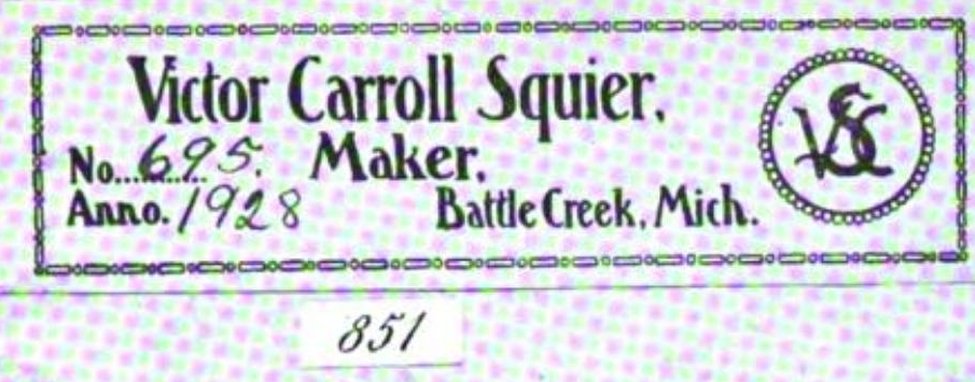
Instrument No. 695 by 1928: the label facsimile in Poidras reads “No. 695 … Anno 1928,” both completed in manuscript.
Plate facsimile 851, on the leaf facing p. 256 of Poidras vol. 2 (1930), read from the page image. Two numbering systems meet here and must not be confused: 695 is Squier’s own instrument number, written on the label; 851 is Poidras’s number for the facsimile. An earlier seeding cited plate 852, which is Reindahl’s.
Printed label: “Victor Carroll Squier, Maker, Battle Creek, Mich.”, with “No.” and “Anno” blanks completed in manuscript and a circular VCS monogram at the right.
The same plate-851 reading, from the page image. The label prints the full name the directory abbreviates to “Victor C.”
The father’s standing in the reference literature: “after the Civil War noted as one of the best American violin-makers, with headquarters at Boston.”
Pratt, ed., Grove’s American Supplement (1920), p. 42, read from the page image; the entry ends “See Violinist’s Guide (1916), p. 39,” so Grove’s defers to the Guide for its facts. Entered as the father’s context; it says nothing of Victor.
Named in 4 books printed between 1916 and 1937. Read by a person from the page images, not yet checked by a person against the page. Entries from 4 books stand under this name, and nobody has judged yet whether they mean the same person.
Details and sources
Record note
The son of the maker Boston violin teachers called “the Stradivarius of America,” and the point where a bench trade became a string factory. Jerome Bonaparte Squier’s memorial entry in the 1916 Violinist’s Guide — 608 violins made and reconstructed, the “Apostles” series of twelve, each named after an apostle — stands on the same page as his son’s plain line: maker, repairer and dealer at 429 Lake Ave., Battle Creek, Michigan, manufacturer of wound strings. Ayars’s 1937 history of the Boston trade supplies the join the directory only implies — Victor Carroll “worked with him” before opening his own business — and notes the family had come from Michigan in the first place. By 1928 his labels, carrying the full name the directory abbreviates over a VCS monogram, were numbered to at least 695. What no source here supplies is a single personal date for him.
What the books say
- Places and dates of work
- Battle Creek, Michigan — 429 Lake Ave., coded “m.r.d.”, maker, repairer and dealer, in the 1916 trade directory. documented read from the page image
- Output (claimed and documented)
- Manufacturer of wound strings, alongside making, repair and dealing. reported read from the page image
- Partners, pupils, employees
- Son of Jerome Bonaparte Squier (born Ohio 1838, died Boston 1912), and worked with him: “His son, Victor Carroll, who worked with him, now has his own business in Battle Creek, Michigan, as stringed instrument maker, repairer and dealer, and manufacturer of wound strings.” The family’s road ran through Michigan: the father “came from Michigan to Lewiston, Maine,” where he took up violins, and thence to Boston. reported read from the page image
- Partners, pupils, employees
- “Son of J. B. Squier” — the directory’s line; the father’s memorial entry stands on the same page: “Made and reconstructed 608 violins… One of foremost American makers; work highly esteemed,” with the “Apostles” series of twelve violins, each named after an apostle, and the “George Washington” and “Abraham Lincoln.” reported read from the page image
- Partners, pupils, employees
- The father’s standing in the reference literature: “after the Civil War noted as one of the best American violin-makers, with headquarters at Boston.” reported read from the page image
- Numbering practice
- Instrument No. 695 by 1928: the label facsimile in Poidras reads “No. 695 … Anno 1928,” both completed in manuscript. documented read from the page image
- Labels and brands
- Printed label: “Victor Carroll Squier, Maker, Battle Creek, Mich.”, with “No.” and “Anno” blanks completed in manuscript and a circular VCS monogram at the right. documented read from the page image
- What is not known
- His dates, and everything after 1928. No birth or death year is attested in the corpus — the Guide and Ayars both leave him living and undated — and the string business’s later history under his name is outside this record’s evidence. Michigan vital records or Battle Creek directories would settle the dates; the Guide’s later editions (1917, 1920, 1924) would date the shop. disputed [no source recorded]
Instruments
No instruments recorded yet for this maker.
The books behind this record
This record draws on 4 sources, all read from the page image. The count weighs how well each source was read, not just how many are cited. A stack of half-read sources does not outweigh one page read properly.
- The Violinist’s Guide: Written for the Use of the Violin Buying Public (Chicago: The Violinist Publishing Company, 1916), pp. 19–43. Google Books, zXQHAQAAMAAJ. https://books.google.com/books?id=zXQHAQAAMAAJ.
The Violinist’s Guide (1916), p. 39, read from the page image. The listing is the directory’s print; the note beneath it — “American; maker, repairer and dealer. Son of J. B. Squier. Manufacturer of wound strings.” — is self-supplied and entered separately. The Guide (1916), p. 39, read from the page image; self-supplied. Ayars (1937) repeats the phrase, citing the Guide as her footnote — the same statement twice, not two witnesses. It is the earliest attestation on record of the string manufacture carried on under his name. The Guide (1916), p. 39, read from the page image. Victor’s note is self-supplied; the father’s deceased-maker entry is the compiler’s own memorial. The same volume’s advertising pages, p. 43, disperse “the violin collection of the late J. Bonaparte Squier” — the contact printed there is “J. E. Squier, 2 Park Square, Boston,” not Victor.
- Ayars, Christine Merrick, Contributions to the Art of Music in America by the Music Industries of Boston, 1640–1936 (New York: H. W. Wilson Co., 1937), pp. 12–15, 21–22, 197–200, 205, 208, 234–35, 258–63, 272. archive.org, contributionstoa00ayar. https://archive.org/details/contributionstoa00ayar.
Ayars (1937), pp. 198–200, read from the page images. Her footnote for the Victor paragraph is the Guide’s p. 39 — which says “son of,” not “worked with him” — so the working link is her own addition, unsourced in the entry.
- Pratt, Waldo Selden, ed., Grove’s Dictionary of Music and Musicians: American Supplement, Being the Sixth Volume of the Complete Work (New York: Macmillan, 1920), p. 8, 24, 39, 42, 217, 369. archive.org, grovesdictionary00grovrich. https://archive.org/details/grovesdictionary00grovrich.
Pratt, ed., Grove’s American Supplement (1920), p. 42, read from the page image; the entry ends “See Violinist’s Guide (1916), p. 39,” so Grove’s defers to the Guide for its facts. Entered as the father’s context; it says nothing of Victor.
- Poidras, Henri, Critical and Documentary Dictionary of Violin Makers Old and Modern (Rouen: Imprimerie de la Vicomté, 1930), 2:256. Google Books, pHQHAQAAMAAJ, pg PA256-IA31; also HathiTrust mdp.39015012793934, image seq. 413. https://books.google.com/books?id=pHQHAQAAMAAJ.
Plate facsimile 851, on the leaf facing p. 256 of Poidras vol. 2 (1930), read from the page image. Two numbering systems meet here and must not be confused: 695 is Squier’s own instrument number, written on the label; 851 is Poidras’s number for the facsimile. An earlier seeding cited plate 852, which is Reindahl’s. The same plate-851 reading, from the page image. The label prints the full name the directory abbreviates to “Victor C.”
Mentioned, not yet worked
1 source on file names this maker, but no claim has been written from it yet. That is a statement of work outstanding, recorded in the open rather than hidden — and an invitation. If you can add anything to this record — a document, an instrument, a family memory — the gap below is exactly where it fits.
- District of Columbia Historical Records Survey, Bio-Bibliographical Index of Musicians in the United States of America since Colonial Times (Washington, D.C.: Music Section, Pan American Union, 1956). archive.org, biobibliographic00dist. https://archive.org/details/biobibliographic00dist. s.v., alphabetical index — no printed folio in the OCR source recordprinted as “Squier, Victor Carroll”
Violin-maker. A 200.