Bow & Bridge Violin and bow makers, as the old books printed them

Craft: Violin maker

  • Squier, Victor Carroll

    The son of the maker Boston violin teachers called “the Stradivarius of America,” and the point where a bench trade became a string factory. Jerome Bonaparte Squier’s memorial entry in the 1916 Violinist’s Guide — 608 violins made and reconstructed, the “Apostles” series of twelve, each named after an apostle — stands on the same page as his son’s plain line: maker, repairer and dealer at 429 Lake Ave., Battle Creek, Michigan, manufacturer of wound strings. Ayars’s 1937 history of the Boston trade supplies the join the directory only implies — Victor Carroll “worked with him” before opening his own business — and notes the family had come from Michigan in the first place. By 1928 his labels, carrying the full name the directory abbreviates over a VCS monogram, were numbered to at least 695. What no source here supplies is a single personal date for him.
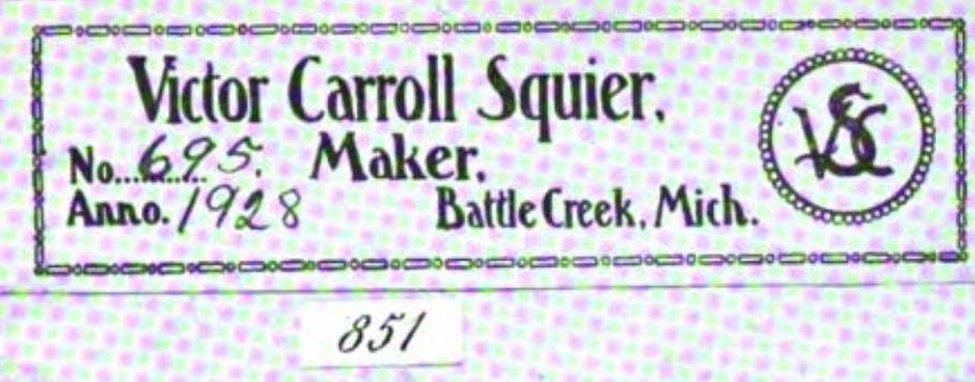
    A printed violin label inside a plain rectangular frame of chain-link ornament. Bold condensed type reads Victor Carroll Squier on the first line, then Maker, then Battle Creek, Mich. Two blanks are completed by hand in ink: 695 after No., and 1928 after Anno. At the right, inside a beaded circle, a monogram interlaces the letters V, C and S. Below the frame the plate prints its facsimile number, 851, in a small ruled box. A coarse halftone dot screen from the 1930 printing lies over the whole image.
    Squier’s Battle Creek label, numbered 695 by hand and dated 1928 — the highest number recorded for him, and the printed source for the VCS monogram. Detail (facsimile 851) of the plate leaf facing p. 256 in Henri Poidras, Critical and Documentary Dictionary of Violin Makers Old and Modern, vol. 2 (Rouen: Imprimerie de la Vicomté, 1930), read from the Google Books page image — full source record. Published 1930; its United States copyright has expired — public domain.
    Places and dates of work
    Battle Creek, Michigan — 429 Lake Ave., coded “m.r.d.”, maker, repairer and dealer, in the 1916 trade directory. documented read from the page image
    Output (claimed and documented)
    Manufacturer of wound strings, alongside making, repair and dealing. reported read from the page image
    Partners, pupils, employees
    Son of Jerome Bonaparte Squier (born Ohio 1838, died Boston 1912), and worked with him: “His son, Victor Carroll, who worked with him, now has his own business in Battle Creek, Michigan, as stringed instrument maker, repairer and dealer, and manufacturer of wound strings.” The family’s road ran through Michigan: the father “came from Michigan to Lewiston, Maine,” where he took up violins, and thence to Boston. reported read from the page image
    Partners, pupils, employees
    “Son of J. B. Squier” — the directory’s line; the father’s memorial entry stands on the same page: “Made and reconstructed 608 violins… One of foremost American makers; work highly esteemed,” with the “Apostles” series of twelve violins, each named after an apostle, and the “George Washington” and “Abraham Lincoln.” reported read from the page image
    Partners, pupils, employees
    The father’s standing in the reference literature: “after the Civil War noted as one of the best American violin-makers, with headquarters at Boston.” reported read from the page image
    Numbering practice
    Instrument No. 695 by 1928: the label facsimile in Poidras reads “No. 695 … Anno 1928,” both completed in manuscript. documented read from the page image
    Labels and brands
    Printed label: “Victor Carroll Squier, Maker, Battle Creek, Mich.”, with “No.” and “Anno” blanks completed in manuscript and a circular VCS monogram at the right. documented read from the page image
    What is not known
    His dates, and everything after 1928. No birth or death year is attested in the corpus — the Guide and Ayars both leave him living and undated — and the string business’s later history under his name is outside the evidence held. Michigan vital records or Battle Creek directories would settle the dates; the Guide’s later editions (1917, 1920, 1924) would date the shop. disputed [no source recorded]

    Instruments

    No instruments recorded yet for this maker.
  • Gemunder, George

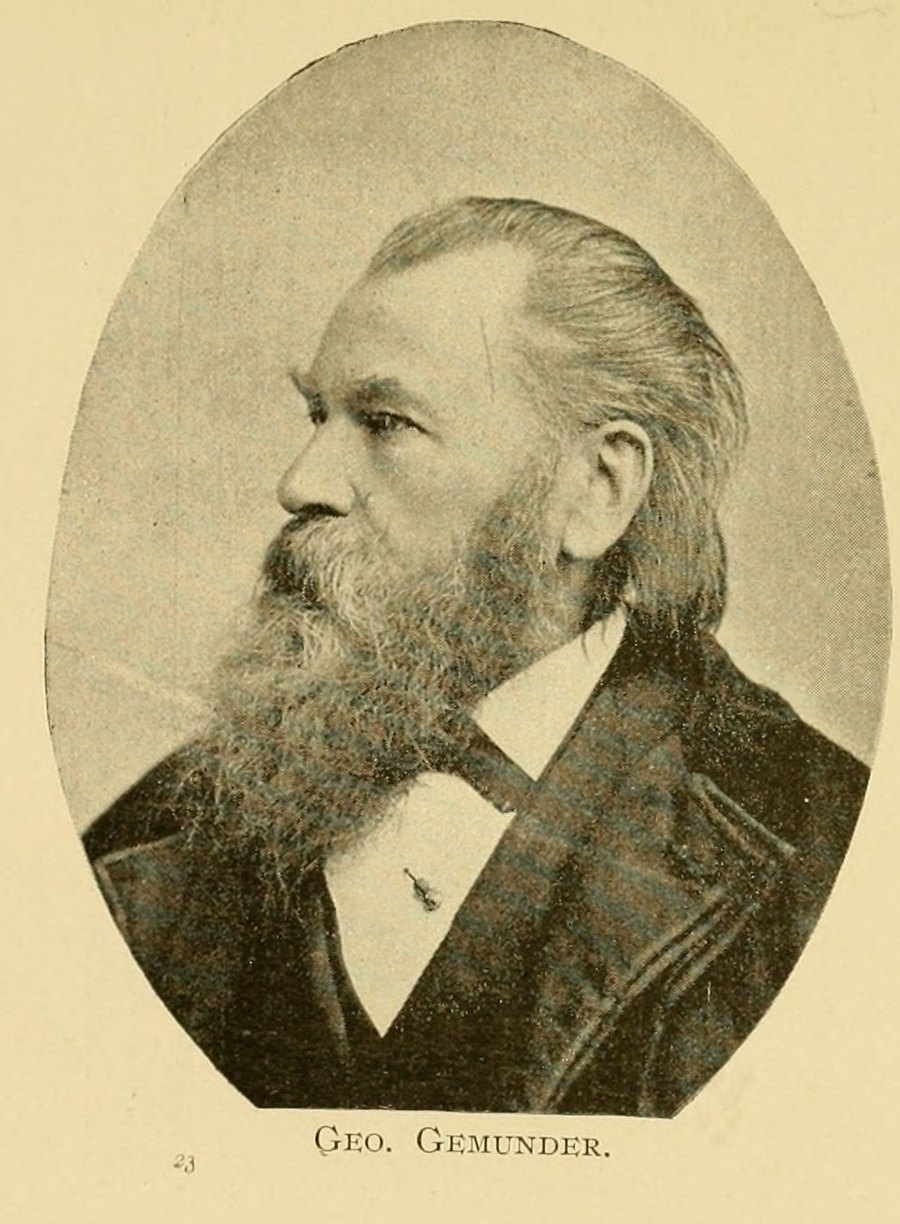
    George Gemunder the elder — born at Ingelfingen in Württemberg on 13 April 1816, dead in 1899 — was a pupil of Vuillaume and, on the period literature’s own showing, the leading figure in nineteenth-century American violin making. Howe’s 1889 compendium, published while Gemunder was still at work in New York, opens its violin-making pages with “First upon the list should come the name of George Gemunder,” and Hubbard’s 1908 trade history opens its account of the brothers with “The most important name connected with American violin making is that of Gemunder” — the name, not the man: Hubbard attaches it to the family, and treats August first. The name did not retire with him. A son George, “said to have inherited his father’s genius,” died on Long Island in 1915; the family firm was still in the 1916 directory; three more Gemunders stood on the 1914 Academy roll. So “George Gemunder” on a label or in a sale record is not yet one man, and the claims below belong to the elder George only where the sources say so. Howe’s three pages and portrait have been read from the page images; the Grove’s American Supplement entry and the Ayars pages have not been read.

    A half-length halftone photograph of an elderly man in three-quarter profile facing left, printed inside an oval whose top rises to a point. He has a long full beard going white, hair swept back from a high forehead and worn long over the ears, and a dark coat over a white wing collar and dark bow tie; a small violin-shaped stickpin is set in the shirt front. Beneath the oval, in spaced small capitals, the printed caption reads GEO. GEMUNDER. A small numeral 23 is printed low and to the left, clear of the caption. The leaf is toned cream, and the halftone screen is plainly visible across the darker areas of coat and beard.
    Gemunder photographed for the volume that opened its violin-making pages “First upon the list should come the name of George Gemunder” — ten years before his death, and while he was still at work in New York. The portrait leaf in (Granville L. Howe, ed.); W. S. B. Mathews, assoc. ed., A Hundred Years of Music in America (Chicago: G. L. Howe, 1889), bound between printed pp. 348 and 350. The leaf carries no printed folio of its own: it is cited as p. 349 on the strength of the numbers printed on the two leaves that flank it, and the 23 beside the portrait is a binder’s signature mark, not a page number. The plate is bound sideways and is turned here to be read. Read from the archive.org scan of the University of Connecticut copy — full source record. Published 1889; public domain.
    Born (date and place)
    13 April 1816, at Ingelfingen in Württemberg. reported view the page image
    Died (date and place)
    — reported1
    Emigration / arrival
    In 1847 “he received an invitation from his two brothers residing in America to visit this country.” A concert venture with the brothers was “not lucrative,” and “borrowing twenty-five dollars as capital to invest in business, he went to Boston to engage in violin making.” disputed view the page image
    Emigration / arrival
    — disputed1
    Training
    Bred to the craft — his father “was a maker of bow instruments”; schooled for teaching instead; after his father died in his nineteenth year he went through Pesth, Presburg, Vienna and Munich, then obtained an engagement with Vuillaume and remained several years in the Paris shop, “making and repairing violins for the distinguished artists and amateurs of the day.” reported view the page image
    Places and dates of work
    Boston, from soon after the 1847 arrival until about 1851 — the business there “was not remunerative” — then New York: “Mr. Gemunder has remained in New York ever since,” still at work there when the sketch went to press in 1889. reported view the page image
    Places and dates of work
    New York, in business with his brother August; later independent in Astoria. reported read from the page image
    Awards and exhibitions
    First prizes at the London exposition of 1851, for “a quartette of bow instruments in imitation of Stradivarious, also several other violins,” sent while he worked in Boston; the news reached him in New York, “shortly after his arrival.” reported view the page image
    Awards and exhibitions
    “The violins of George Gemunder took highest awards at Centennial Exposition, Philadelphia, 1876; at Paris Exposition” — the Paris fair unnamed and undated. reported read from the page image
    Partners, pupils, employees
    Brother and partner: August Gemunder. The successor firm, August Gemunder & Sons of 141 W. 42nd St., stands in the same 1916 directory, its president — another August — described there as “nephew of George Gemunder.” reported read from the page image
    Partners, pupils, employees
    A son, George, “said to have inherited his father’s genius,” died on Long Island, 1915. reported read from the page image
    Partners, pupils, employees
    — reported1
    Named players and patrons
    Ole Bull — on whom he called in New York in 1852, and to whom, over a violin Bull “believed Vuilluame had repaired for him,” Gemunder “proved to Mr. Bull that he, himself, and not the master workman, had done the marvelous repairing.” reported view the page image
    Wood
    — reported1
    Market history
    — reported1
    What is not known
    Which George is which, in any given attribution: the maker (1816–1899) and his son George (d. 1915) shared the name entire, and no instrument, label or sale on disk is assigned between them. Also unestablished: a death record behind the index’s 1899 — Howe (1889) leaves him alive and working in New York, so the death falls between that press date and the 1916 directory’s “Deceased”; and the identity of the Paris exposition, which Howe, naming only the London prizes, does nothing to supply. Of the six works the WPA index keys his entry to, Hubbard and now Howe (pp. 347–49, with the portrait) are on disk and read; Grove’s American Supplement, Jones’s Handbook, Pratt’s encyclopedia and the Ayars pages (198, 228) remain unread. disputed [no source recorded]

    How the pages were read

    5 of the 15 lines here were read from machine text (software that turns a photo of a page into words), not by a person looking at the page image.

    Notes

    1. Read from machine text (software that turns a photo of a page into words, or a typed transcription), not by a person looking at the page image. ↩

    Instruments

    No instruments recorded yet for this maker.

  • Becker, Carl

    A Chicago maker whose family became one of the most significant in American violin making. He appears at the start of his career in a 1916 trade directory, at the same address as two other makers, and again a century later at the top of the American auction market.

    Father and son are not separated below. Which of the two a given source refers to is not established.

    Born (date and place)
    Born 1887, American. reported read from the page image
    Places and dates of work
    59 E. Adams Street, Chicago, in 1916. documented read from the page image
    Training
    Fifteen years’ experience by 1916, implying a start around 1901. reported read from the page image
    Training
    — reported1
    Models and patterns
    Copyist of Stradivari and Guarneri “in all respects but varnish.” reported read from the page image
    Market history
    — reported1
    What is not known
    Carl Becker Sr. and Carl Becker Jr. are not yet distinguished here. disputed [no source recorded]

    How the pages were read

    2 of the 6 lines here were read from machine text (software that turns a photo of a page into words), not by a person looking at the page image.

    Notes

    1. Read from machine text (software that turns a photo of a page into words, or a typed transcription), not by a person looking at the page image. ↩

    Instruments

    No instruments recorded yet for this maker.

  • Wilkanowski, William

    A prolific Brooklyn maker whose auction record is one of the few American benchmarks with enough sales to be statistically meaningful. Little else is recorded: the entry carries what the sources establish and nothing else.

    Places and dates of work
    — reported1
    Output (claimed and documented)
    — reported1
    Market history
    — reported1
    What is not known
    Birth and death dates, training, and place of origin are not yet established from any source read. disputed [no source recorded]

    How the pages were read

    3 of the 3 lines here were read from machine text (software that turns a photo of a page into words), not by a person looking at the page image.

    Notes

    1. Read from machine text (software that turns a photo of a page into words, or a typed transcription), not by a person looking at the page image. ↩

    Instruments

    No instruments recorded yet for this maker.