Bow makerCello makerViola makerViolin makerChicago, Illinois, Madison, Wisconsin1857–1936
As printed
Critical and Documentary Dictionary of Violin Makers Old and Modern (1930)
Described himself as self-taught in violin making.
Three incompatible accounts survive: self-taught (his own, twice); a pupil of the Danish maker Paulsen; and an apprentice of the Chicago maker John Hornsteiner. None is settled.source record
“570 violins and 300 bows” to date, per his entry in Poidras (1930). The commonly circulated figure is 585 violins, 20 violas and 20 cellos.
Both figures may simply read the highest known instrument number as a violin count. The 20-viola figure has never been traced to a single actual instrument.source record
Numbered his instruments in a running series: the label facsimile Poidras reproduced as plate 852 reads “#570, October, 1928” in the maker’s hand.
The plate, not the text entry: Poidras's entry at 2:231–32 attests a count — "570 violins and 300 bows" — not a series, and reaches the facsimile only through its "N° 852" key. Dated label numbers from No. 315 (1907) to No. 582 (1932) stand in the instrument register below, each on its own source; a dealer listing gives #569 in July 1929 against the facsimile's #570 of October 1928 — a higher number carrying an earlier date, and the facsimile is the stronger evidence. A "No. 253 (1904)" once carried on this row is forum-sourced and untraced to any document; it is withdrawn. That cellos ran a separate low sequence — the one numbered cello carries #10 for 1917–18 — is this project's inference from the register, not an attested fact.source record
The Violinist's Guide: Written for the Use of the Violin Buying Public (1916)
“Learned wood carving trade” — trained as a woodcarver before violin making.
His own account, given to a directory that printed what makers supplied and declined to vouch for it.
Chicago, “formerly twenty years in Athenaeum Bldg.” by his own 1916 account; Madison, Wisconsin, where the same entry gives his address in 1916.
He claimed "twenty years in Athenaeum Bldg." in 1916; dated addresses support about fourteen, roughly 1901 to 1915. The 1902 Lakeside directory independently places him on Van Buren that year, as the sole name under "Violins. (Makers and Repairers.)" — though its street number is OCR-corrupt and unusable, and it gives no room number at all. Room 300 is attested in 1901 and room 318 not before 1907. He also kept a working Madison atelier from at least 1912, so the move was a migration rather than a date.
Coded “m.r.” — maker and repairer — in the 1916 trade directory.
The Guide notes that every maker may usually be assumed a repairer, so an explicit "r." reflects what the man himself reported. This bears directly on attribution: his label, brand or repair work can all appear in an instrument he did not make. A 1908 Musical Courier description of re-graduating work in his shop was removed from this row: the passage has not been read at image resolution, its transcription is flagged do-not-quote with a suspected dittography, and no source record for it exists.
Bronze medal, Class 17 (Musical Instruments), Exposition Universelle, Paris, 1900.
Printed as a gold medal by Wenberg, Henley and Holmes. The federal record says bronze, and cites no qualities. No known source has Reindahl himself claiming gold.
Show all 6 printings
This claim names a source that has no page on this site yet, so it cannot be checked. It is shown rather than hidden.Whether he reached Chicago in 1876 or 1889. Whether any viola of his survives.
No viola by him appears in any indexed auction record, dealer listing, museum collection or photograph found to date.
Mo parish register, Øvre Telemark
16 November 1857, Mo, Øvre Telemark, Norway.
His Who's Who entries for both 1928–29 and 1930–31 give 1858 — his baptism year — but he did not give it consistently: his self-supplied 1916 Guide entry prints "Born Norway, 1857" and Poidras (1930) "Born in Norway in 1857." The parish register is the stronger evidence.
A History and Genealogical Record of the Felland and Reindahl Families (1940)
17 January 1936, aged 78.
The date is fixed by five independent contemporary notices and the family history; Decorah-Posten adds "Fredag," and 17 January 1936 was a Friday. The place is a different matter and is left open here. The NTB wire and Nordisk Tidende put his death at his home on Lake Monona; the longer Skandinaven obituary, reprinted in the Telemark press, says he died in a hospital in Madison, and gives the day as the 7th — a day no other source supports. Telen should not be cited for either the day or the place. The conflict is recorded, not resolved.
Named in 5 books printed between 1901 and 1940. Read partly by software from scans, partly from the page images, checked by a person against the page. Entries from 5 books stand under this name, and nobody has judged yet whether they mean the same person.
Details and sources
Record note
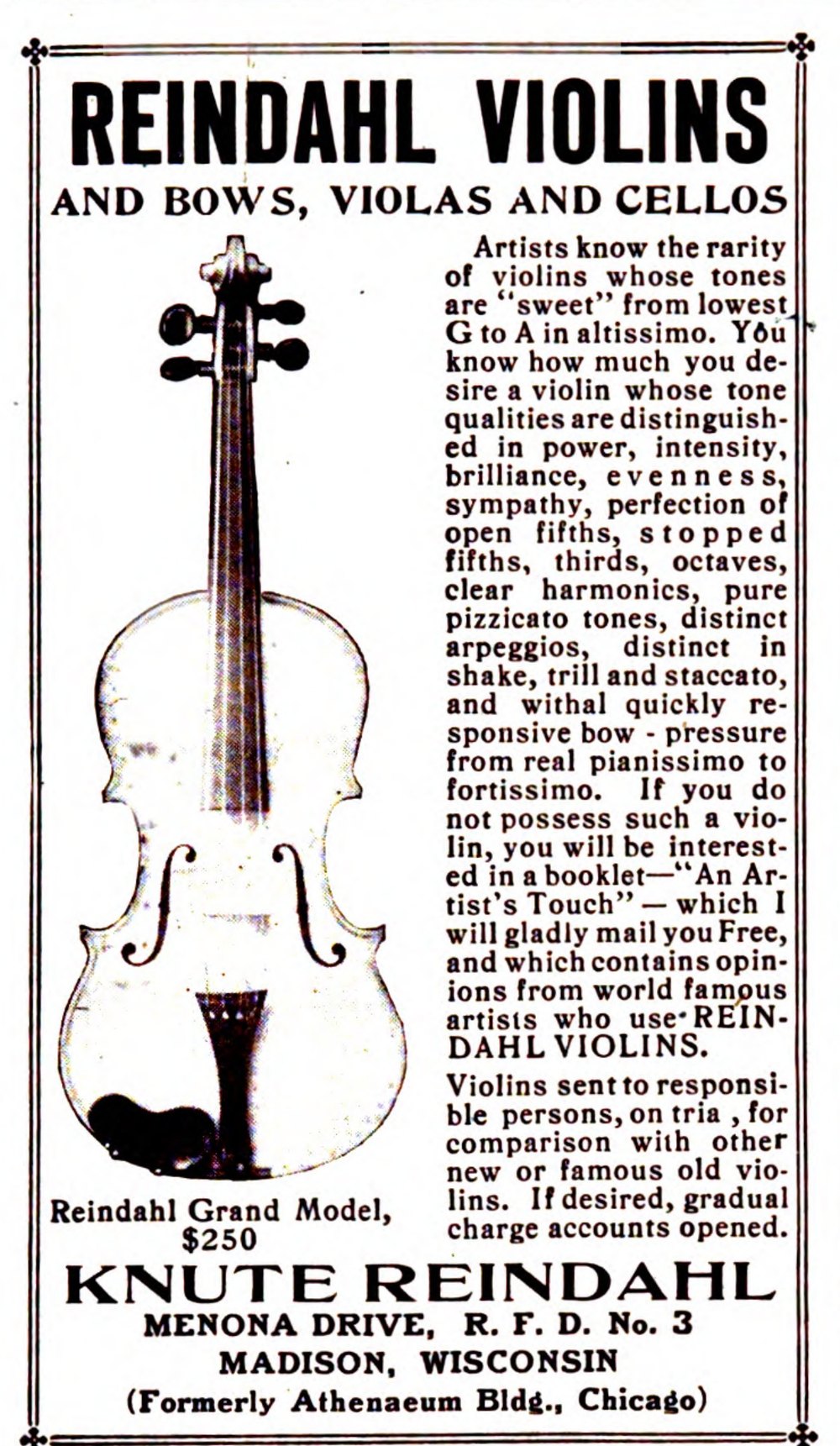
A Norwegian-born woodcarver who became the best-known violin maker in Wisconsin, and whose published record is substantially wrong. He is the pilot record for this reference: the corrections below are traceable, and where the evidence runs out the entry says so.
What the books say
- Born (date and place)
- 16 November 1857, Mo, Øvre Telemark, Norway. corrected1
- Training
- “Learned wood carving trade” — trained as a woodcarver before violin making. reported read from the page image
- Training
- Described himself as self-taught in violin making. disputed read from the page image
- Places and dates of work
- Chicago, “formerly twenty years in Athenaeum Bldg.” by his own 1916 account; Madison, Wisconsin, where the same entry gives his address in 1916. reported read from the page image
- Awards and exhibitions
- Bronze medal, Class 17 (Musical Instruments), Exposition Universelle, Paris, 1900. corrected1
- Output (claimed and documented)
- “570 violins and 300 bows” to date, per his entry in Poidras (1930). The commonly circulated figure is 585 violins, 20 violas and 20 cellos. reported read from the page image
- Numbering practice
- Numbered his instruments in a running series: the label facsimile Poidras reproduced as plate 852 reads “#570, October, 1928” in the maker’s hand. reported read from the page image
- Repair and rework practice
- Coded “m.r.” — maker and repairer — in the 1916 trade directory. documented read from the page image
- What is not known
- Whether he reached Chicago in 1876 or 1889. Whether any viola of his survives. disputed [no source recorded]
- Died (date and place)
- 17 January 1936, aged 78. documented1
How the pages were read
3 of the 9 lines here were read from machine text (software that turns a photo of a page into words), not by a person looking at the page image.
Notes
- Read from machine text (software that turns a photo of a page into words, or a typed transcription), not by a person looking at the page image. ↩
Instruments
No instruments recorded yet for this maker.
No instruments with both a parseable number and a parseable date for this maker.
The books behind this record
This record draws on 5 sources. Each is listed below with how it was read, because a claim read from a photo of the page is stronger than one read from machine text.
Against the standard accounts
- Poidras, Critical & Documentary Dictionary, vol. 2 (1930), 2:231–32 with plate 852 — cites no sources. Read here from the page images. The entry cites nothing; Poidras compiled his American entries from what makers supplied to the 1916 trade directory, so it is Reindahl's own report at one remove — the "570 violins and 300 bows" arrived together with the label facsimile, as one supply.
- Wenberg, The Violin Makers of the United States (1986), p. 245 — citation practice not established here. Not independently viewed in a physical copy. As recovered, the entry repeats the maker's self-supplied 1916 directory entry verbatim — down to "Made first instrument in 1867", the year that drifted onto the wrong line of a form — and prints as gold the medal the federal award list records as bronze.
- Henley, Universal Dictionary of Violin & Bow Makers, entry "Reindahl, Knute" — citation practice not established here. Known here only through a transcription; the printed volume was not independently viewed. It cites nothing in that transcription, repeats the gold-medal error, and misnames the professional body he headed.
- Mo parish register, Øvre Telemark. Arkivverket / Digitalarkivet, AV/SAKO-A-286/F/Fa/L0006.
His Who's Who entries for both 1928–29 and 1930–31 give 1858 — his baptism year — but he did not give it consistently: his self-supplied 1916 Guide entry prints "Born Norway, 1857" and Poidras (1930) "Born in Norway in 1857." The parish register is the stronger evidence.
- The Violinist’s Guide: Written for the Use of the Violin Buying Public (Chicago: The Violinist Publishing Company, 1916), pp. 19–43. Google Books, zXQHAQAAMAAJ. https://books.google.com/books?id=zXQHAQAAMAAJ.
His own account, given to a directory that printed what makers supplied and declined to vouch for it. He claimed "twenty years in Athenaeum Bldg." in 1916; dated addresses support about fourteen, roughly 1901 to 1915. The 1902 Lakeside directory independently places him on Van Buren that year, as the sole name under "Violins. (Makers and Repairers.)" — though its street number is OCR-corrupt and unusable, and it gives no room number at all. Room 300 is attested in 1901 and room 318 not before 1907. He also kept a working Madison atelier from at least 1912, so the move was a migration rather than a date. The Guide notes that every maker may usually be assumed a repairer, so an explicit "r." reflects what the man himself reported. This bears directly on attribution: his label, brand or repair work can all appear in an instrument he did not make. A 1908 Musical Courier description of re-graduating work in his shop was removed from this row: the passage has not been read at image resolution, its transcription is flagged do-not-quote with a suspected dittography, and no source record for it exists.
- Poidras, Henri, Critical and Documentary Dictionary of Violin Makers Old and Modern (Rouen: Imprimerie de la Vicomté, 1930), 2:231–32. HathiTrust, mdp.39015012793934.
Three incompatible accounts survive: self-taught (his own, twice); a pupil of the Danish maker Paulsen; and an apprentice of the Chicago maker John Hornsteiner. None is settled. Both figures may simply read the highest known instrument number as a violin count. The 20-viola figure has never been traced to a single actual instrument.
- Report of the Commissioner-General for the United States to the International Universal Exposition, Paris, 1900 (Washington, DC: Government Printing Office, 1901), vol. 5, p. 68. archive.org, reportofcommissi05unit_0.
Printed as a gold medal by Wenberg, Henley and Holmes. The federal record says bronze, and cites no qualities. No known source has Reindahl himself claiming gold.
- Poidras, Henri, Critical and Documentary Dictionary of Violin Makers Old and Modern (Rouen: Imprimerie de la Vicomté, 1930), 2:256. Google Books, pHQHAQAAMAAJ, pg PA256-IA31; also HathiTrust mdp.39015012793934, image seq. 413. https://books.google.com/books?id=pHQHAQAAMAAJ.
The plate, not the text entry: Poidras's entry at 2:231–32 attests a count — "570 violins and 300 bows" — not a series, and reaches the facsimile only through its "N° 852" key. Dated label numbers from No. 315 (1907) to No. 582 (1932) stand in the instrument register below, each on its own source; a dealer listing gives #569 in July 1929 against the facsimile's #570 of October 1928 — a higher number carrying an earlier date, and the facsimile is the stronger evidence. A "No. 253 (1904)" once carried on this row is forum-sourced and untraced to any document; it is withdrawn. That cellos ran a separate low sequence — the one numbered cello carries #10 for 1917–18 — is this project's inference from the register, not an attested fact.
- Felland, Carl Martin, A History and Genealogical Record of the Felland and Reindahl Families (Northfield, MN: Mohn Printing Co., 1940), pp. 78–79. archive.org, historygenealogi00fell. https://archive.org/details/historygenealogi00fell.
The date is fixed by five independent contemporary notices and the family history; Decorah-Posten adds "Fredag," and 17 January 1936 was a Friday. The place is a different matter and is left open here. The NTB wire and Nordisk Tidende put his death at his home on Lake Monona; the longer Skandinaven obituary, reprinted in the Telemark press, says he died in a hospital in Madison, and gives the day as the 7th — a day no other source supports. Telen should not be cited for either the day or the place. The conflict is recorded, not resolved.
Mentioned, not yet worked
2 sources on file name this maker, but no claim has been written from them yet. That is a statement of work outstanding, recorded in the open rather than hidden — and an invitation. If you can add anything to this record — a document, an instrument, a family memory — the gaps below are exactly where it fits.
- Hubbard, W. L., ed., History of American Music, The American History and Encyclopedia of Music (Toledo: Irving Squire, 1908), pp. 258, 332–34. archive.org, historyamerican00damrgoog. https://archive.org/details/historyamerican00damrgoog. p. 333 source recordprinted as “Knute Reindahl”
“Knute Reindahl of Chicago is a successful maker of artistic violins, violas and violoncellos. He constructs his instruments from very old wood obtained from the ancient cities of Norway which he believes to be the only place in the world where woods of the requisite age and proper seasoning can be obtained. Among the violinists who endorse Reindahl’s violins are Franz von Vecsey, Hugo Heermann, Sauret, Arthur Hartmann, Rosenbecker, Kubelik, Kreisler, and others.”
- District of Columbia Historical Records Survey, Bio-Bibliographical Index of Musicians in the United States of America since Colonial Times (Washington, D.C.: Music Section, Pan American Union, 1956). archive.org, biobibliographic00dist. https://archive.org/details/biobibliographic00dist. s.v., alphabetical index — no printed folio in the OCR source recordprinted as “Reindahl, Knute”
Violin-maker. AH 333.