George Gemunder the elder — born at Ingelfingen in Württemberg on 13 April 1816, dead in 1899 — was a pupil of Vuillaume and, on the period literature’s own showing, the leading figure in nineteenth-century American violin making. Howe’s 1889 compendium, published while Gemunder was still at work in New York, opens its violin-making pages with “First upon the list should come the name of George Gemunder,” and Hubbard’s 1908 trade history opens its account of the brothers with “The most important name connected with American violin making is that of Gemunder” — the name, not the man: Hubbard attaches it to the family, and treats August first. The name did not retire with him. A son George, “said to have inherited his father’s genius,” died on Long Island in 1915; the family firm was still in the 1916 directory; three more Gemunders stood on the 1914 Academy roll. So “George Gemunder” on a label or in a sale record is not yet one man, and the claims below belong to the elder George only where the sources say so. Howe’s three pages and portrait have been read from the page images; the Grove’s American Supplement entry and the Ayars pages have not been read.
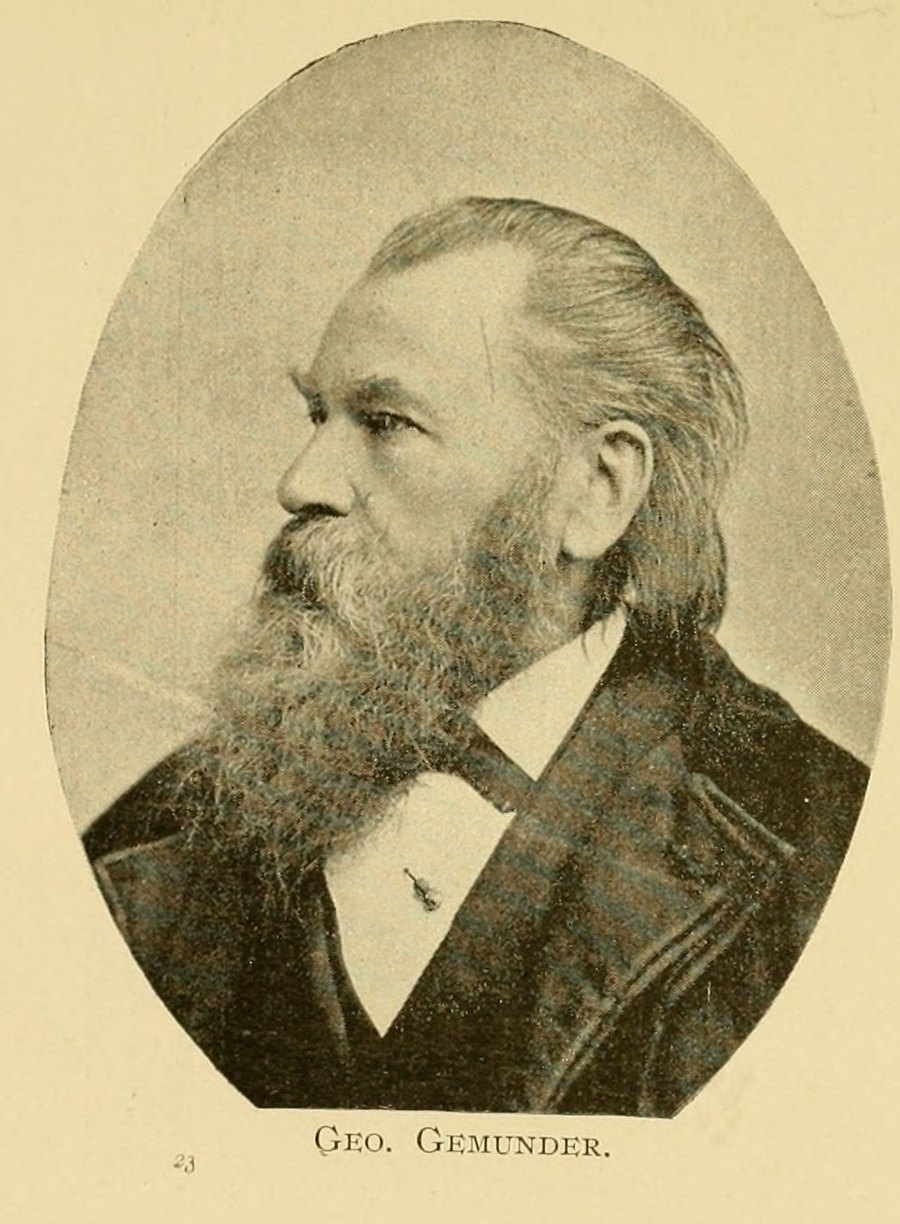
- Born (date and place)
- 13 April 1816, at Ingelfingen in Württemberg. reported view the page image
- Died (date and place)
- — reported1
- Emigration / arrival
- In 1847 “he received an invitation from his two brothers residing in America to visit this country.” A concert venture with the brothers was “not lucrative,” and “borrowing twenty-five dollars as capital to invest in business, he went to Boston to engage in violin making.” disputed view the page image
- Emigration / arrival
- — disputed1
- Training
- Bred to the craft — his father “was a maker of bow instruments”; schooled for teaching instead; after his father died in his nineteenth year he went through Pesth, Presburg, Vienna and Munich, then obtained an engagement with Vuillaume and remained several years in the Paris shop, “making and repairing violins for the distinguished artists and amateurs of the day.” reported view the page image
- Places and dates of work
- Boston, from soon after the 1847 arrival until about 1851 — the business there “was not remunerative” — then New York: “Mr. Gemunder has remained in New York ever since,” still at work there when the sketch went to press in 1889. reported view the page image
- Places and dates of work
- New York, in business with his brother August; later independent in Astoria. reported read from the page image
- Awards and exhibitions
- First prizes at the London exposition of 1851, for “a quartette of bow instruments in imitation of Stradivarious, also several other violins,” sent while he worked in Boston; the news reached him in New York, “shortly after his arrival.” reported view the page image
- Awards and exhibitions
- “The violins of George Gemunder took highest awards at Centennial Exposition, Philadelphia, 1876; at Paris Exposition” — the Paris fair unnamed and undated. reported read from the page image
- Partners, pupils, employees
- Brother and partner: August Gemunder. The successor firm, August Gemunder & Sons of 141 W. 42nd St., stands in the same 1916 directory, its president — another August — described there as “nephew of George Gemunder.” reported read from the page image
- Partners, pupils, employees
- A son, George, “said to have inherited his father’s genius,” died on Long Island, 1915. reported read from the page image
- Partners, pupils, employees
- — reported1
- Named players and patrons
- Ole Bull — on whom he called in New York in 1852, and to whom, over a violin Bull “believed Vuilluame had repaired for him,” Gemunder “proved to Mr. Bull that he, himself, and not the master workman, had done the marvelous repairing.” reported view the page image
- Wood
- — reported1
- Market history
- — reported1
- What is not known
- Which George is which, in any given attribution: the maker (1816–1899) and his son George (d. 1915) shared the name entire, and no instrument, label or sale on disk is assigned between them. Also unestablished: a death record behind the index’s 1899 — Howe (1889) leaves him alive and working in New York, so the death falls between that press date and the 1916 directory’s “Deceased”; and the identity of the Paris exposition, which Howe, naming only the London prizes, does nothing to supply. Of the six works the WPA index keys his entry to, Hubbard and now Howe (pp. 347–49, with the portrait) are on disk and read; Grove’s American Supplement, Jones’s Handbook, Pratt’s encyclopedia and the Ayars pages (198, 228) remain unread. disputed [no source recorded]
How the pages were read
5 of the 15 lines here were read from machine text (software that turns a photo of a page into words), not by a person looking at the page image.
Notes
- Read from machine text (software that turns a photo of a page into words, or a typed transcription), not by a person looking at the page image. ↩
Instruments
No instruments recorded yet for this maker.